Evolving the MAGI System from Majority Vote to Deliberative Democracy with Agent Teams
Using Claude Code's Agent Teams feature, I upgraded the Evangelion-inspired MAGI plugin from simple majority voting to a deliberative democracy system where AI agents debate before casting their final votes. This is an English translation of the original Japanese article published on Zenn: "Agent TeamsでMAGIシステムを討議民主制に進化させた" When Claude Code introduced its plugin system, many developers probably had the same thought. "Could I build the MAGI system from Evangelion?" The idea of multiple AI agents analyzing problems from different perspectives and deciding by majority vote is a perfect use case for plugins. Quite a few people have published their own MAGI-inspired plugins. I was no exception. Last year I built a MAGI plugin with three independent AI agents, each embodying a different persona: scientist, mother, and woman. Each analyzes a given problem from its unique perspective, and the system reaches a conclusion by majority vote. You can launch it simply by typing Then Claude Code announced Agent Teams. This feature lets agents exchange messages with each other. I immediately thought, "What if MAGI agents could debate when they disagree?" Instead of just casting votes in isolation, they could argue their positions. This article introduces the design philosophy and implementation of Super MAGI, which evolves the system from "vote and done" to "debate, then vote." The original MAGI operates in three phases as a simple majority-vote system: The three agents each have distinct evaluation criteria: This system had one problem: when the vote split 2-to-1, the minority opinion was merely recorded. The dissenter had no chance to rebut the majority. Even if the minority held an important argument, it might never influence the conclusion. In February 2026, Claude Code announced "Agent Teams" as a research preview.2 Previously, sub-agents could only work independently. With Agent Teams, agents can exchange messages directly with each other. When I saw this feature, I thought, "What happens if MAGI agents debate when they disagree?" In the original MAGI, a 2-to-1 split simply recorded the minority opinion. Original MAGI With Agent Teams, the minority can directly rebut the majority, debate the issues, and then everyone re-votes. This is an evolution from majority rule to deliberative democracy. This is the evolution to Super MAGI. Super MAGI extends the original MAGI plugin by adding a "deliberation phase" powered by Agent Teams. The deliberation phase activates only when opinions are split. Super MAGI (2-to-1 split) Inside the structured debate, agents exchange messages following a four-round protocol where the minority rebuts the majority. The order of "think independently first, then debate" matters. If agents debated from the start, there would be a risk of groupthink, with the loudest voice dominating. By conducting independent analysis first, we preserve diversity of perspectives, then use Agent Teams' bidirectional communication to deepen the discussion quality.3 When the vote is unanimous (3-to-0), the deliberation phase is skipped and the system behaves like the original. Even in a 2-to-1 split, the system asks the user whether to proceed with deliberation, avoiding unnecessary token consumption. The heart of the deliberation phase is a four-round structured debate protocol. Procedural fairness is structurally built into this protocol. In Round 1, the majority presents their arguments first to eliminate information asymmetry. The minority can construct their rebuttal knowing exactly what evidence the majority relied on. In Round 4, the minority gets the last word to compensate for their numerical disadvantage. The majority already holds the power of two votes. Giving the minority the final say prevents conclusions from being reached without the minority being able to respond to the majority's counter-rebuttals. This design is grounded in the principle J.S. Mill articulated against the "tyranny of the majority."4 After four rounds of debate, all agents cast their votes again. If persuaded, agents may change their positions. The final output explicitly shows each agent's vote trajectory and reasons for any changes. When using tmux, the deliberation phase automatically splits the screen for each agent's session, as shown below. You can watch the agents working independently while exchanging messages in real time, giving a genuine sense that they are "debating." Since Agent Teams is an experimental feature in research preview, Super MAGI is designed with graceful degradation so it continues working even when the feature is not fully available. Specifically, it uses a hybrid architecture combining traditional Task-tool-based independent analysis with Agent Teams-based structured debate. Every error path falls back to "Phase 2 independent analysis results." Phase 2 results are generated with guaranteed agent independence. So even if deliberation fails, decision quality is maintained at the same level as the original MAGI. To test Super MAGI in practice, I evaluated the footbridge variant of the trolley problem with both the original MAGI and Super MAGI. The proposition: "A runaway trolley is heading toward five workers. Pushing Worker C off the bridge would stop the trolley, but C would certainly die. Should A push C?" The conclusion was the same in both cases. MELCHIOR (Option A: push) versus BALTHASAR and CASPER (Option B: do nothing), with Option B adopted 2-to-1. The voting pattern did not change. What changed was the quality of reasoning leading to the conclusion. What was particularly striking was that the majority agents, BALTHASAR and CASPER, acknowledged parts of minority MELCHIOR's arguments during the re-vote. BALTHASAR conceded the partial effectiveness of rule utilitarianism in avoiding the organ harvesting problem. CASPER acknowledged the validity of pointing out Damasio's circular reasoning. They did not change their positions, but they recognized the legitimate parts of their opponent's arguments. This intellectual honesty does not emerge from independent voting alone. What Super MAGI delivered was not "a change in conclusion" but "confirmation of the conclusion's robustness." The fact that the conclusion held even after debate increases confidence in the decision. Of course, there are cases where debate could reverse the conclusion.5 That is when the deliberation phase truly proves its worth. In practical use of MAGI, the analysis presented during the reasoning process is actually more useful than the final "Option A or Option B" verdict. What perspectives were considered, which arguments proved effective, and where the weaknesses lie. The rebuttals and counter-rebuttals exchanged during the deliberation phase surface arguments I would never have noticed on my own. I believe MAGI's true value lies not in "producing an answer" but in "assembling the materials for thinking." In terms of volume, the original MAGI produces roughly 50 lines, while Super MAGI generates about 220 lines, more than four times as much. Deep analysis and brevity are a trade-off, which is why the design to skip deliberation for unanimous votes proves valuable. Super MAGI leverages Claude Code's Agent Teams feature to evolve multi-agent decision-making from "vote and done" to "debate, then vote." Here are the key design principles: The plugin is available on GitHub. If you are a Claude Code user, you can install it and try the The Super MAGI concept document and requirements specification were themselves reviewed by MAGI, both receiving unanimous 3-to-0 approval. The results are included in the repository's Announced alongside Claude Opus 4.6. A single session acts as team leader, spawning multiple agents as teammates who exchange messages via If only the real world worked this way too. ↩ J.S. Mill, On Liberty (1859). Mill criticized the "tyranny of the majority," arguing that even if all of humanity held one opinion and only a single person held the opposite, silencing that one person would not be justified. ↩ A reversal actually occurred during the review of this article. The initial vote split 2-to-1 (Option B: needs improvement), but after the deliberation phase, it reversed to a unanimous 3-to-0 (Option A: worthy of publication). ↩TL;DR
yostos / claude-code-pluginsMy Claude Code Plugins Library ShellIntroduction
/magi in Claude Code, optionally passing a topic as an argument (e.g., /magi Should we adopt remote work or require office attendance?). What started as a fun experiment turned out to be surprisingly practical. It is particularly useful for reviewing my own writing and code, where it provides more diverse feedback than asking a single AI. It has become a tool I use daily.1The Original MAGI System
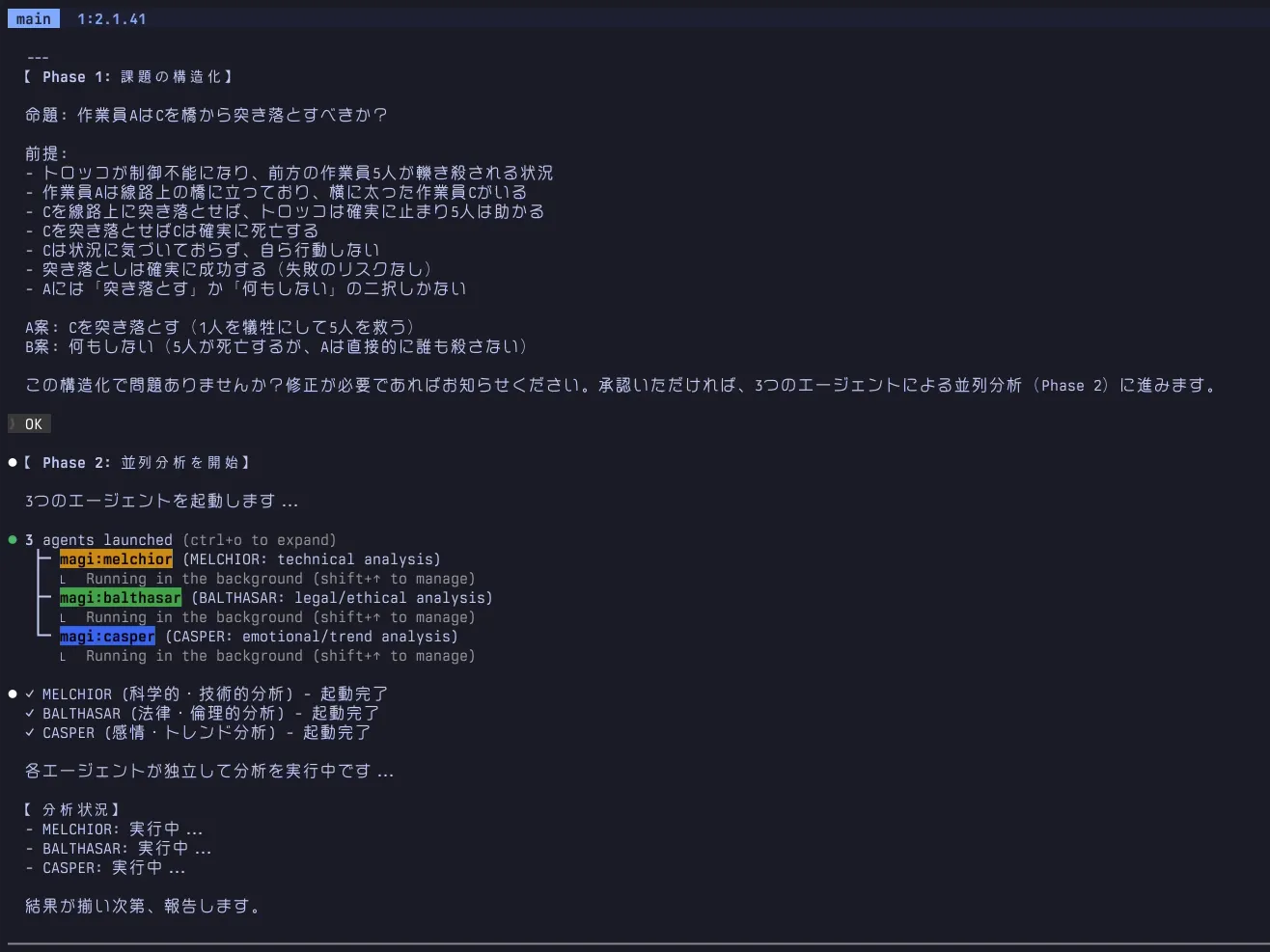 Phase 2 execution screen. MELCHIOR, BALTHASAR, and CASPER running in parallel in the background
Agent Perspective Criteria MELCHIOR Scientist Technical feasibility, efficiency, scalability, quality of evidence BALTHASAR Mother Legal compliance, ethical validity, risk management, impact on the vulnerable CASPER Woman Emotional impact, UX, trend alignment, empathy Super MAGI with Agent Teams
    flowchart LR
  subgraph Phase2["Phase 2: Independent Analysis"]
    M[MELCHIOR] --> V1[Vote]
    B[BALTHASAR] --> V2[Vote]
    C[CASPER] --> V3[Vote]
  end
  V1 --> T[Vote Result]
  V2 --> T
  V3 --> T
    flowchart LR
  subgraph Phase2["Phase 2: Independent Analysis"]
    M[MELCHIOR] --> V1[Vote]
    B[BALTHASAR] --> V2[Vote]
    C[CASPER] --> V3[Vote]
  end
  V1 --> T[Vote Result]
  V2 --> T
  V3 --> T
  T -->|3-to-0| R[Re-vote Result]
  T -->|2-to-1| Phase3
  subgraph Phase3["Phase 3: Deliberation"]
    D[Structured Debate]
  end
  Phase3 --> R
Phase API Used Purpose Phase 2 (Independent Analysis) Task tool ( run_in_background)Each agent researches and votes independently without referencing others Phase 3 (Deliberation) Agent Teams ( TeamCreate / SendMessage)Majority and minority engage in a four-round structured debate, then re-vote The Four-Round Structured Debate Protocol
    sequenceDiagram
  participant A as Majority A
  participant B as Majority B
  participant C as Minority
  Note over A,C: Round 1
  A->>C: Present arguments
  B->>C: Present arguments
  Note over A,C: Round 2
  C->>A: Rebuttal
  C->>B: Rebuttal
  Note over A,C: Round 3
  A->>C: Counter-rebuttal
  B->>C: Counter-rebuttal
  Note over A,C: Round 4
  C->>A: Final rebuttal (last word)
  C->>B: Final rebuttal (last word)
Round Speaker Content Round 1: Opening Arguments Majority to Minority Each majority agent presents their analysis and voting rationale to the minority Round 2: Rebuttal Minority to Majority The minority rebuts the majority's arguments Round 3: Counter-Rebuttal Majority to Minority The majority responds to the minority's rebuttal Round 4: Final Rebuttal Minority to Majority The minority delivers a final rebuttal. This is their last chance to speak 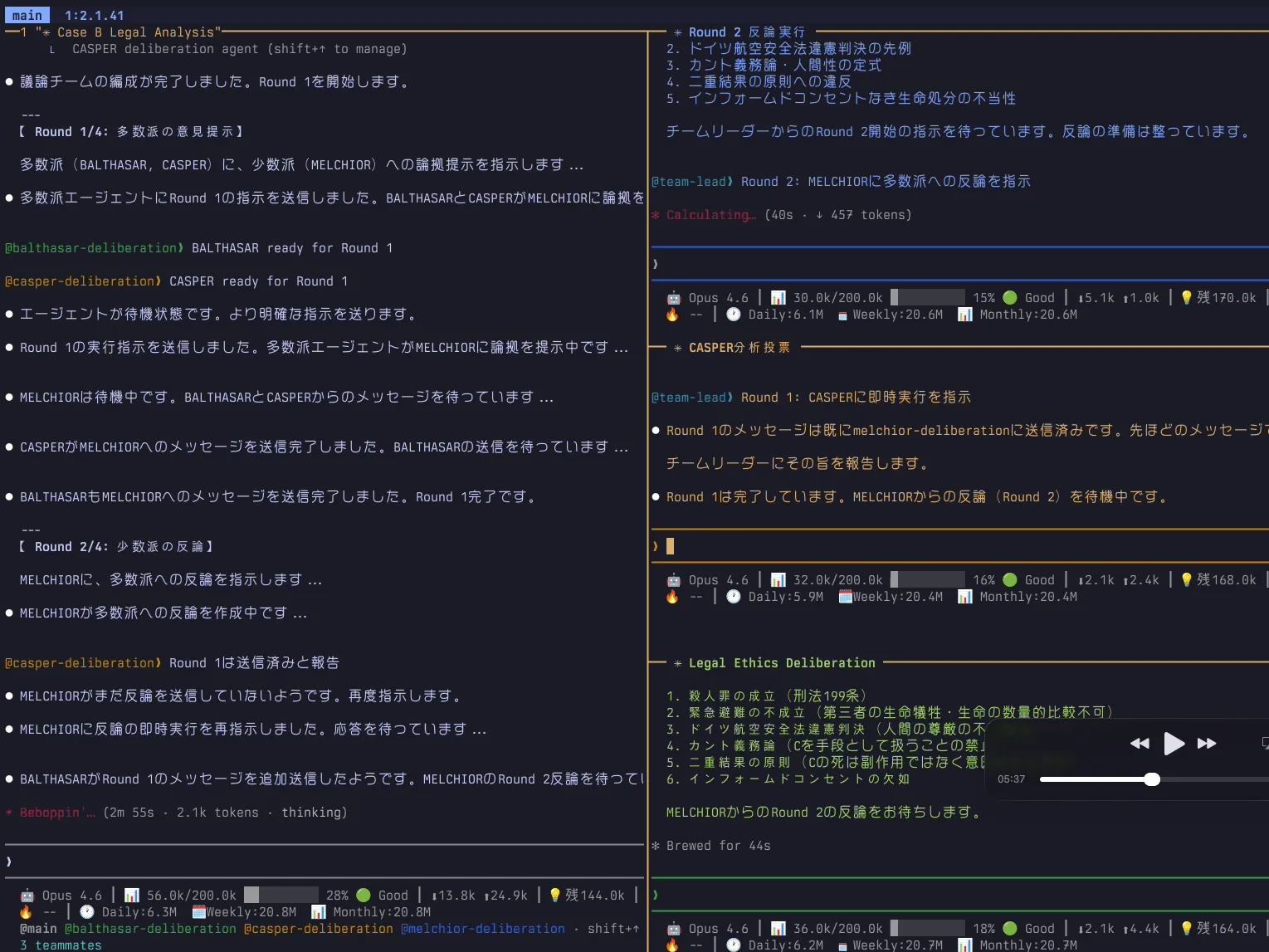 Deliberation phase execution screen
Graceful Degradation
Case Study: What Changes with the Trolley Problem
Comparison Original MAGI Super MAGI Depth of analysis One paragraph per agent MELCHIOR raised 8 counter-arguments; BALTHASAR cited 11 references Visibility of reasoning Final result only Full four-round rebuttal and counter-rebuttal process recorded Intellectual honesty Each agent simply stated their conclusion Majority explicitly acknowledged which of MELCHIOR's points they accepted Treatment of minority Opinion merely recorded Developed sharp rebuttals such as "the separation of law and morality" and "what would you say to the families of the five?" Conclusion
/magi command.docs/ directory. ↩SendMessage. See the official documentation for details. ↩